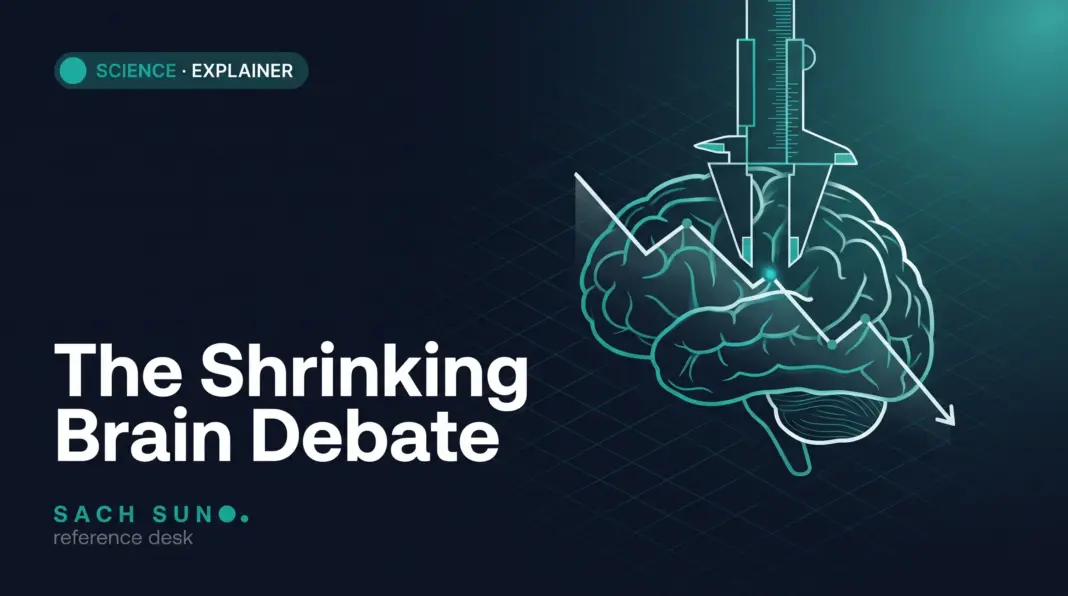
The idea that human brains have become smaller sounds like a contradiction. Modern societies have built satellites, vaccines, languages, cities, and artificial intelligence, so a smaller average brain can seem like a sign of decline. Scientists are much more cautious.
Brain size is not the same as intelligence. The better question is whether average cranial volume has changed during recent human history, what the evidence shows, and why experts disagree about the meaning of the trend.
What the evidence suggests
Live Science reported that several researchers see evidence for a reduction in average human brain size over parts of the Holocene, the epoch that began after the last ice age. Some estimates place the decline at roughly 10% or about 150 millilitres, though the exact figure depends on which skeletal samples are used.
A 2021 paper by Jeff Morgan Stibel in Brain, Behavior and Evolution found evidence of decreases in brain size and encephalization among anatomically modern humans. Other researchers, however, argue that the data are more complicated and may be affected by body size, nutrition, sample bias, sex differences, ancestry, and geography.
Why smaller does not mean less intelligent
Brain size is only one biological measure. Neural organization, connectivity, development, culture, language, education, and tools all influence what humans can do. A larger skull does not automatically produce better reasoning, and a smaller brain does not automatically mean lower intelligence.
Modern humans also rely heavily on collective knowledge. No individual has to remember every plant, route, toolmaking method, or astronomical pattern if that knowledge is distributed across books, institutions, digital systems, and specialists.
Possible explanations
Researchers have suggested several explanations. Agriculture and permanent settlement may have changed diets, body size, physical demands, and social organization. Warmer climates after the last ice age may have favoured smaller bodies in some populations. More complex societies may also have shifted cognitive burdens from individuals to groups.
None of these explanations should be presented as settled fact. A high-quality article should show the debate, not pretend one theory solves the question.
Why the debate matters
The topic matters because it pushes readers to separate simple biological measures from cultural assumptions. It also helps explain why human evolution did not stop when modern humans appeared. Bodies, diets, diseases, environments, and social systems continue to shape human biology.
For AdSense-readiness, the article should avoid deterministic claims about intelligence, race, sex, or modern society. The safe and useful approach is to explain the evidence, uncertainties, and competing hypotheses.
Why the evidence is hard to interpret
Studying ancient brain size usually means estimating from skulls, not measuring preserved brains. That makes sample selection important. Skulls come from different regions, time periods, sexes, diets, body sizes, and preservation conditions. A dataset that overrepresents one population can make a trend look stronger or weaker than it really is.
Researchers also have to decide whether to compare absolute brain volume or brain size relative to body size. If bodies became smaller, some brain-size reduction may reflect overall body-size change rather than a direct change in cognition. That is why the best scientific coverage presents the disagreement instead of forcing a simple answer.
What the debate does not prove
The evidence does not prove that modern humans are less intelligent than ancient humans. It also does not justify ranking groups of people by biology. The useful takeaway is narrower and more interesting: human evolution is complex, and brain volume alone is a poor shortcut for understanding intelligence, culture, or adaptation.
Key takeaways
- Some researchers find evidence that average human brain size declined in recent prehistory.
- Brain size is not a direct measure of intelligence.
- Scientists disagree about timing, causes, and sample interpretation.
- The best framing is a science debate, not a claim that humans are becoming less intelligent.