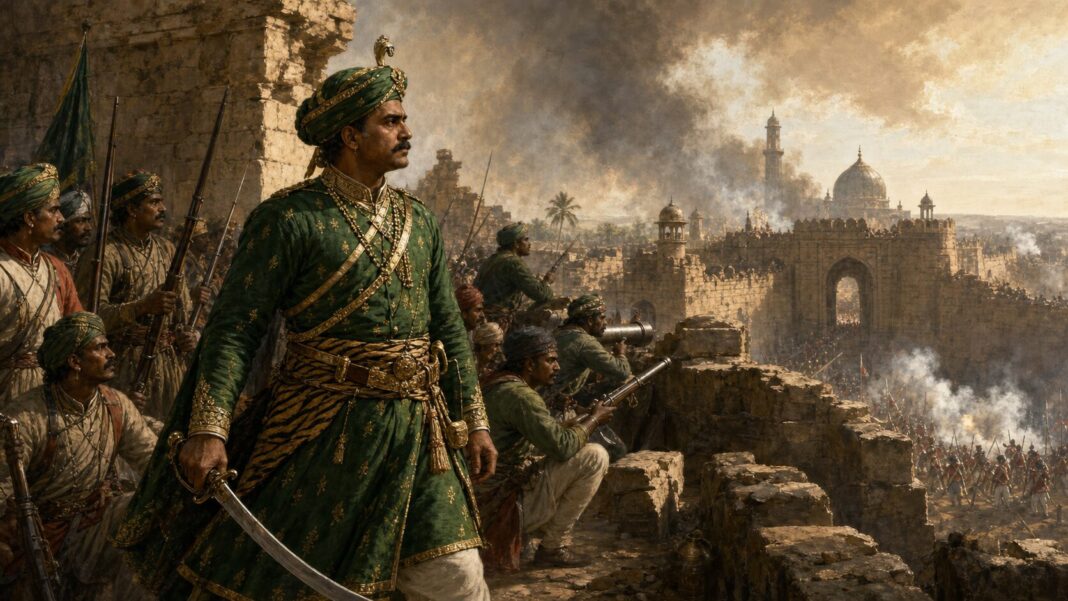
On 4 May 1799, the walls of Seringapatam were breached. The army outside was larger, better supplied, and supported by powerful Indian allies. The defenders had endured weeks of bombardment. Their ruler, Tipu Sultan of Mysore, knew that the British East India Company did not merely want another treaty. It wanted the political destruction of the state that had resisted it more stubbornly than almost any other power in India.
Tipu did not survive the afternoon. His body was found after dark beneath a heap of the dead near a gateway on the northern side of the fortress. Even accounts written by men serving the victorious army place him in the fighting as the city fell. He had not left his capital to save himself. He had not emerged as a captive. His last hours ended not in a palace negotiation but amid the violent defence of Seringapatam.
That ending explains why Tipu Sultan remains more than an eighteenth-century king. To admirers, he is the Tiger of Mysore: a ruler who understood the danger of Company expansion early, built a state capable of resisting it, recovered after a crushing defeat, and chose to share the fate of his soldiers rather than accept a life stripped of sovereignty. His courage has often been wrapped in legend, but it does not need legend. The documented choices are powerful enough.
This is the story of those choices. It is also a story that requires care. Tipu was an ambitious monarch, not a modern constitutional nationalist. His campaigns brought suffering to communities in Malabar and Coorg, and arguments over coercion, captivity, religion, and memory remain serious. A responsible account should neither erase those histories nor allow later controversy to make his resistance to colonial expansion disappear. Heroism is not the same as perfection. It is revealed most clearly in what a person does when defeat is close and the cost of standing firm becomes personal.
At a glance: why Tipu Sultan’s last stand matters
- Tipu Sultan ruled Mysore from 1782 until his death in 1799.
- He and his father, Hyder Ali, made Mysore the most persistent military obstacle to East India Company expansion in southern India.
- The 1784 Treaty of Mangalore ended the Second Anglo-Mysore War on broadly reciprocal terms, a rare diplomatic setback for the Company.
- After losing roughly half his territory in 1792 and surrendering two sons as hostages, Tipu rebuilt rather than submit to dependent rule.
- His forces combined disciplined infantry, cavalry, artillery, fortifications, and innovative iron-cased rockets.
- When Seringapatam was stormed in 1799, he remained in the fortress and was killed in close fighting near its northern gate.
- His death did not preserve Mysore’s independence, but it made visible the human price of refusing political surrender.
A dangerous age for independent Indian states
Tipu Sultan was born in 1750, when political power in the subcontinent was being reorganised. Mughal authority had weakened. Regional states, military households, merchant networks, European companies, and local rulers competed for revenue, ports, forts, and alliances. The British East India Company was still a commercial corporation in law, but commerce had become inseparable from armed power. Its servants collected taxes, maintained armies, negotiated treaties, and interfered in succession disputes. Victory at Plassey in 1757 and the acquisition of revenue rights in Bengal in 1765 gave the Company resources that could be converted into further military expansion.
In southern India, Mysore rose under Hyder Ali, Tipu’s father. Hyder had advanced through military service and became the effective ruler of the kingdom while the Wodeyar dynasty remained in the background. He was not born into an old royal house. His authority rested on command, political intelligence, revenue, and the ability to maintain an army in a period when weak states could be swallowed quickly.
Tipu grew up inside this world of campaigns and negotiation. He was trained for command, accompanied military expeditions while young, and learned that the Company’s strength came from more than European drill. It could draw on Indian revenues, Indian soldiers, coastal supply lines, financial credit, and alliances with Indian powers. To resist it, Mysore needed more than courage on a battlefield. It needed an organised state.
This point is essential to understanding Tipu’s later reputation. He was not simply a warrior who happened to fight the British. He belonged to a ruling project that recognised the Company as a political and strategic threat. The National Army Museum describes Mysore under Hyder and Tipu as one of the greatest threats to British expansion, able to combine Indian methods with imported military knowledge. That judgement comes from an institution preserving the history of the army that defeated him. The fear he generated was not invented by later admirers.
From soldier-prince to Sultan of Mysore
Tipu’s early military career unfolded during recurring conflict among Mysore, the Company, the Marathas, Hyderabad, and rulers along the Malabar coast. Alliances shifted because no state confronted a simple contest between “India” and “Britain.” Indian powers fought one another, cooperated with European companies, and changed partners when circumstances demanded. Tipu did the same. Any account that turns the period into a single uncomplicated national war loses the political reality that made Company expansion possible.
Yet within that complicated system, Mysore’s hostility to the Company was unusually durable. Hyder Ali’s invasion of the Carnatic in 1780 produced one of the gravest crises the British had faced in southern India. Mysorean forces inflicted a devastating defeat on a Company detachment at Pollilur. Rockets, cavalry, artillery, and coordinated pressure helped break a force accustomed to disciplined battlefield success. The event became a lasting warning that European-led armies were not invincible.
Hyder died in December 1782 while the Second Anglo-Mysore War was still being fought. Tipu inherited not a peaceful throne but a war. A less determined successor might have sought immediate safety on whatever terms the Company offered. Tipu maintained the struggle and proved that Mysore’s resistance had not depended on his father alone.
He was in his early thirties when he became ruler. The transfer of authority was handled quickly enough to deny enemies the opening that a disputed succession could have created. Tipu continued operations on the western coast, where access to ports and supplies mattered greatly. By 1784, both sides were exhausted. The result was the Treaty of Mangalore.
The Treaty of Mangalore: a rare moment of equality
Signed on 11 March 1784, the Treaty of Mangalore ended the Second Anglo-Mysore War. Its language restored conquests and prisoners on reciprocal terms. It did not make Tipu master of the Company, and it did not end the rivalry. Its importance lies in something more precise: the Company had been compelled to negotiate directly with an Indian ruler it had failed to defeat.
The surviving text of the treaty presents two political parties making mutual commitments. That image is striking because later Company settlements so often placed Indian rulers in subordinate positions. Mangalore instead represented a pause between powers that still treated one another as dangerous equals.
For Tipu, the treaty was proof that resistance could work. He had inherited a difficult war, refused to collapse, and brought it to a negotiated conclusion. For Company officials, the result was a humiliation to be reversed. Peace did not remove the conflict. It gave both sides time to prepare for its next phase.
This is one source of the heroic interpretation of Tipu’s life. His defiance was not theatrical. In 1784 it produced a concrete strategic result. The Company had immense resources and was learning how to turn Indian revenues into Indian conquest. Mysore still forced it to stop.
Building a state that could resist
Tipu understood that bravery without administration would be consumed by a long war. His reign therefore involved continuous efforts to centralise authority, regularise revenue, strengthen forts, supervise trade, and maintain military production. Historians disagree about the effectiveness and social cost of these policies, but the direction is clear: Mysore was being organised to survive in a competitive military world.
A scholarly study published by Cambridge University Press describes Hyder and Tipu as rulers who pursued administrative, socio-economic, and military “protomodernisation.” The term should not be mistaken for a claim that Mysore was a modern nation-state. It means that the regime sought new levels of central direction, record keeping, production, and military capacity before colonial rule was imposed.
Tipu reorganised offices and districts, issued regulations to officials, introduced new coin names and a new calendar, and treated royal symbols as instruments of authority. He intervened heavily in commerce and tried to direct the trade in valuable commodities. State trading establishments and overseas contacts were intended to reduce dependence on networks vulnerable to British pressure. Policies designed to feed the treasury and army could also be intrusive. Centralisation looks efficient from the capital and burdensome to people compelled to supply it; both perspectives belong in the history.
He also encouraged specialised production and invited technical knowledge from abroad. Mysore required guns, powder, rockets, cloth, paper, metalwork, and the many less glamorous supplies that kept soldiers in the field. Tipu’s court was not merely consuming luxury. It was trying to build the material base of sovereignty.
The ambition can be seen in the library found after Seringapatam fell. According to the National Army Museum, more than 2,000 books and manuscripts were taken to the East India Company’s directors. A ruler interested only in battlefield glory would not have assembled such a collection. Its seizure also reminds us that conquest did not end at the city wall. Knowledge, weapons, art, treasure, and royal objects were carried away and reinterpreted by the victor.
The rockets that outlived the kingdom
Mysorean rockets have become the most famous example of military innovation under Hyder and Tipu. Gunpowder rockets were not new, but Mysorean armourers made effective use of iron casings. Iron could withstand greater pressure than traditional soft casings, allowing a more forceful discharge. Fixed to long guiding shafts and deployed by trained units, the rockets were difficult to predict and psychologically disturbing. Their flight was less precise than conventional artillery, but precision was not their only purpose. Noise, flame, movement, and massed fire could disrupt formations and frighten men and horses.
The Victoria and Albert Museum notes that Tipu’s rocket troops wore uniforms incorporating his tiger-stripe motif, while the National Army Museum places the iron-cased rocket alongside the mixture of Indian and European methods that made his forces formidable. These weapons were products of an organised military system, not isolated curiosities.
After the fall of Seringapatam, the British examined captured rockets. Their influence can be traced into the development of the Congreve rocket used by British forces in the nineteenth century. Tipu lost the war, but technology developed in the state he led travelled into the arsenal of the empire that defeated him. That is one of history’s harsher ironies: conquest often presents the knowledge it captures as the innovation of the conqueror.
The rockets matter for another reason. They challenge the old colonial picture of an inventive Europe confronting a static India. Mysore adapted, manufactured, experimented, and learned. Tipu’s resistance was not a refusal to change. It was an attempt to change quickly enough to remain independent.
The tiger as a language of power
Tipu made the tiger inseparable from his kingship. Tiger stripes appeared on weapons, coinage, textiles, furniture, military equipment, and the decoration of the court. The symbol communicated aggression, vigilance, royal force, and a personal connection to his father, Hyder. The most famous surviving object is the mechanical tiger now in the V&A: an almost life-sized animal mauling a European soldier while a concealed organ produces sound.
To British visitors, the object later appeared cruel, exotic, and useful as evidence of the defeated ruler’s supposed fanaticism. In Tipu’s court, it made a different political statement. The expanding Company was not an unavoidable future. The European could be defeated, the tiger could strike back, and Mysore could imagine itself as the active power rather than the victim.
The British understood the symbolism so well that they reversed it. A medal after the 1799 victory showed the British lion subduing the Mysorean tiger. Tipu’s objects were divided, sold, gifted, and exhibited. His image was turned into imperial theatre. The struggle therefore continued in art after the shooting stopped: who was the beast, who was the hero, and whose victory represented order?
Tipu’s answer had been visible across his kingdom. Sovereignty needed a recognisable language. The tiger supplied it.
Diplomacy against encirclement
Tipu also searched for allies beyond India. France was the obvious partner because Anglo-French rivalry stretched across oceans. He communicated with French authorities and welcomed French military expertise. His envoys sought support from the Ottoman world and other rulers. These missions are sometimes retold as grand alliances that were almost ready to destroy the Company. The reality was less dramatic. Distance, conflicting interests, European wars, and British control at sea limited what foreign diplomacy could deliver.
But the strategy itself was rational. Tipu faced a corporation connected to a global empire and international credit. Treating the conflict as a purely local problem would have guaranteed isolation. He tried to place Mysore inside a wider network of enemies of Britain.
The risk was that British officials could present every French contact as proof of an immediate conspiracy. Richard Wellesley, the governor-general who came to India in 1798, favoured an aggressive system that reduced Indian states to dependency through subsidiary alliances. Tipu’s external diplomacy supplied a justification for war, while Wellesley’s broader policy supplied the motive. The Company did not have to wait for a French army to arrive. The possibility of cooperation was enough to describe Mysore as an intolerable threat.
The catastrophe of 1792
The Third Anglo-Mysore War, fought from 1790 to 1792, transformed Tipu’s position. The conflict began after his attack on Travancore, a state allied to the Company. This time the Company did not fight alone. Lord Cornwallis assembled a coalition with the Nizam of Hyderabad and the Marathas. Mysore faced several opponents and the strategic weight of their combined resources.
Tipu fought hard, but the coalition pushed toward Seringapatam. In 1792, with the capital threatened, he accepted a severe settlement. The Treaty of Seringapatam stripped Mysore of roughly half its territory, imposed a large indemnity, and required two of Tipu’s young sons to be delivered as hostages until payment was completed.
The hostage scene became one of the most reproduced images of the war. British art presented Cornwallis as a calm, paternal victor receiving the children. For Tipu, it was a public wound. Territory represented revenue, routes, fortifications, and people. The loss made future defence harder. The surrender of his sons made political defeat intimate.
This was the moment when submission might have appeared practical. Tipu could have accepted that the Company would determine the limits of his power. Other rulers preserved courts, titles, and personal comfort by entering dependent arrangements. The price was strategic freedom.
Tipu chose another path. He paid the indemnity, recovered his sons, and spent the remaining years of his reign rebuilding. That choice did not guarantee success. It may even have made another war inevitable. Yet it tells us what he valued. Kingship without meaningful sovereignty was not enough.
What refusal meant after defeat
It is easy to admire resistance when victory appears possible. The more revealing period is 1792 to 1799, when Tipu knew how powerful the coalition against him could become. He had seen enemy armies reach his capital. He had lost land, money, and diplomatic room. He had watched his children leave as guarantees of his compliance.
He still refused to transform Mysore into a quiet client state.
That refusal was political before it became physical. Tipu restored fortifications, rebuilt units, maintained contact with foreign powers, and continued to treat himself as an independent ruler. He did not behave as though 1792 had settled the future. To Wellesley, this independence was itself the problem. A Mysore able to choose its own allies remained a barrier to the Company’s desired order.
The approaching war was therefore unequal in more than numbers. The Company could lose a campaign and return with revenue from Bengal, support from Britain, Indian credit, and new allies. Tipu could lose his state once. His room for error had narrowed to almost nothing.
His persistence can be criticised as strategically rigid. Perhaps a more accommodating ruler could have preserved a larger Mysorean court for longer. But survival at any price was not Tipu’s measure of success. The state had to retain the capacity to say no. That is the thread linking the Treaty of Mangalore, the reconstruction after 1792, and the final battle.
The road to Seringapatam, 1799
In 1799, Company forces and their allies advanced into Mysore. The invading army under Lieutenant-General George Harris was supported by the Nizam of Hyderabad, whose contingent operated under British direction. Arthur Wellesley, later the Duke of Wellington, held an important command. The force was large, well supplied, and designed to finish the conflict quickly.
Tipu attempted to oppose the advance, including at Mallavelly in March, but was driven back toward Seringapatam. The fortress capital stood on an island in the Kaveri River. Its walls had resisted earlier attacks, but it was not invulnerable. The besiegers brought heavy guns, engineers, disciplined assault troops, and the knowledge gained in previous campaigns.
Inside the city, the strategic situation worsened. Supplies were limited. Bombardment opened damage in the western defences. Negotiations occurred, but the terms demanded from Tipu were extremely severe. Whatever possibility existed for a settlement, it was not a return to the rough equality of Mangalore. The independent power he had defended was to be dismantled.
The National Army Museum’s account of the assault states that the British and their allies greatly outnumbered Tipu’s army. Once a practicable breach had been made, Major-General David Baird led thousands of assault troops forward on 4 May.
They attacked in the heat of the day. The timing sought surprise, as defenders might have expected the main assault at another hour. The storming party crossed the river, reached the breach, and split to clear the ramparts in different directions. What had been a siege became close combat inside the fortifications.
The final hours: what the evidence allows us to say
Later retellings often describe Tipu’s last moments with cinematic certainty: a final speech, a precise exchange with a British soldier, a jewel-studded sword, one last blow, and death consciously chosen in a single perfect instant. Some details may preserve real memories, but the evidence was assembled after a chaotic assault. Participants saw fragments. Survivors had loyalties. British writers were eager to dramatise the death of a famous enemy. Paintings added scenes no artist had witnessed.
A responsible heroic account should not pretend that every movement is known. It should begin with the facts on which the sources converge.
Tipu was inside Seringapatam when the assault began. He was not watching from a secure distance. He moved toward the threatened northern defences and was caught in the struggle near a gateway as British troops penetrated the fortress. He was wounded and killed. His body was not discovered in a private chamber or among civilians seeking concealment. It was recovered from beneath dead combatants near the gate after nightfall.
Alexander Beatson, a Company officer, published a detailed narrative of the campaign in 1800. It is a primary source, but not a neutral one: Beatson wrote within the victorious military establishment and dedicated his work to the Company’s directors. That bias makes careful reading necessary. It also makes the central admission significant. The British account did not present Tipu as a ruler who surrendered and was executed. It placed his death in the resistance to the storm.
A digitised copy of Beatson’s A View of the Origin and Conduct of the War with Tippoo Sultaun preserves the campaign narrative. Major Alexander Allan’s account of the search described Tipu’s body as still warm when it was brought out. The detail conveys how soon the triumphant officers reached the dead ruler after the fighting.
The exact intention behind every movement near the Water Gate is disputed. Accounts differ on whether Tipu was trying to rally defenders, move through the congested gate, reach another position, or preserve a possible route. None of that changes the decisive result. He had remained inside his besieged capital. When the final assault came, he was among armed defenders. He fought, was struck, and died before he could be made a prisoner.
The museum record is unusually direct. The National Army Museum says his body being found under the dead near the northern gate suggests he continued fighting to the end. Another museum page calls him one of India’s greatest warrior princes and says he was killed in the fighting. These are cautious institutional formulations, not nationalist slogans.
Did Tipu Sultan choose death over surrender?
No historian can enter Tipu’s mind in the final seconds. The phrase “chose death” should therefore be understood as an interpretation of a sequence of decisions, not as a quotation from a private thought.
He chose to rebuild after 1792 rather than accept permanent dependency. He chose to continue independent diplomacy despite the risk. He chose to remain at Seringapatam as the invading army closed around it. He did not arrange his own removal to a distant refuge. When the breach was stormed, he entered the defence. He died armed among his men instead of appearing alive before the conquerors.
Taken together, those decisions justify the language of a last stand. Tipu might have sought personal survival through earlier submission. He might have tried to preserve rank by accepting a political order in which the Company controlled Mysore’s external affairs and stationed forces at its expense. He did not.
That does not mean he desired death. Courage is not a wish to die. It is the acceptance that a valued principle may cost one’s life. Tipu’s conduct suggests that sovereignty was such a principle. Once defeat became unavoidable, he did not convert his authority into a bargain for personal safety.
The honour in his death comes from solidarity as much as defiance. Many rulers sent ordinary soldiers into danger while securing escape for themselves. Tipu shared the battlefield fate of the defenders. His body could not be separated from theirs until men searched through the fallen. In death, ruler and soldier occupied the same ground.
The famous tiger quotation – and why the truth is stronger
Tipu is widely credited with a saying that it is better to live briefly as a tiger than for many years as a sheep. Versions differ in both wording and the number of years. The line fits his imagery and the story of his death so perfectly that it is repeated on posters, monuments, social media, and museum displays.
Its precise documentary origin is uncertain, and it should not be treated as a securely recorded final declaration. Tipu’s reputation does not depend on authenticating it. The documented record supplies the meaning that the quotation tries to capture.
For seventeen years as ruler, he confronted a power that was expanding across India. He won a negotiated peace, endured a devastating settlement, rebuilt, and fought again. On the day his capital fell, he was not captured alive. Whether or not he ever spoke the famous sentence in that form, his final political choices gave it force.
History becomes weaker when admiration needs invented certainty. Tipu’s courage becomes clearer when the myth is separated from the evidence.
A hero does not have to be a flawless ruler
Any long account of Tipu Sultan must address the people who remember him very differently. Campaigns in Malabar and Coorg involved severe punishment, forced movement, captivity, and coercion. Evidence for forced conversions has been debated in scale, context, and interpretation, but the subject cannot responsibly be dismissed as though every hostile record were simply a British invention. Communities preserve memories of suffering, and Tipu’s own monarchy used the hard instruments common to eighteenth-century conquest.
At the same time, the opposite caricature – Tipu as nothing but a religious tyrant – also fails to explain the record. His administration included Hindu officials; records connect his rule with gifts or protection involving Hindu institutions; his conflicts were shaped by rebellion, revenue, territory, and war as well as religious language. British propaganda had a strong reason to turn a dangerous political enemy into a moral monster. Modern political arguments have their own reasons to select only one side of the archive.
A useful scholarly discussion in SAGE Open shows how Tipu has moved between colonial condemnation and nationalist celebration. The lesson is not that truth lies mechanically halfway between every claim. It is that evidence must be weighed by origin, context, and corroboration.
Calling Tipu heroic in his resistance does not require declaring every campaign just. A ruler can display extraordinary courage against colonial conquest and still be responsible for coercive rule. Historical maturity is the ability to hold both facts at once.
Indeed, acknowledging the darker record makes the central argument more credible. The case for Tipu’s courage is not built by erasing victims. It is built on his sustained resistance to an expansionist corporation, his preparation of Mysore for survival, and his conduct when his own life was at stake.
Was Tipu Sultan an Indian nationalist?
Tipu lived before the emergence of modern mass nationalism in South Asia. He fought to preserve the sovereignty of Mysore and his dynasty, not to create a democratic republic representing all Indians. His enemies included Indian rulers, and the army that defeated him included large numbers of Indian soldiers. Applying twentieth-century political categories without qualification creates confusion.
But rejecting the anachronism does not make his anti-colonial significance imaginary. The East India Company was extending foreign-controlled corporate rule. Tipu recognised that expansion, opposed it, and became one of its strongest barriers. After his death, the Company partitioned Mysore and restored a reduced Wodeyar kingdom within a system of British dominance. The political consequence was unmistakable.
Tipu can therefore be remembered as a precursor and symbol of anti-colonial resistance without pretending that he possessed the vocabulary of a later nation. Symbols often gain meanings beyond the exact political language of their own age. What later generations saw in him was a ruler who would not consent to subordination.
What changed after the Tiger fell
The fall of Seringapatam removed a major obstacle to Company power in southern India. Mysore was divided. Parts went to the Company and its allies; a smaller kingdom was placed under the restored Wodeyar dynasty within a dependent arrangement. Tipu’s family was removed from power. His treasury and armouries were dispersed. Objects travelled to British houses and museums as trophies.
The mechanical tiger was shipped to London and exhibited by the East India Company. The defeated ruler’s symbol became entertainment in the capital of the power he had resisted. His weapons and royal possessions were presented to officers or sold. His library was sent to the Company’s directors. Conquest was displayed as proof of destiny.
Yet the need for such display revealed how serious the challenge had been. Britain celebrated because Tipu had frightened it. Paintings repeatedly staged his last moments because his death carried dramatic meaning. Medals showed the lion overcoming the tiger because the tiger had been a real rival.
Military victory gave the Company Tipu’s capital. It did not give it final control of his memory.
Why his death still speaks across South Asia
Tipu Sultan’s appeal survives because the moral question at the centre of his last years is larger than Mysore: what is worth risking when a stronger power demands obedience?
He had opportunities to calculate only for himself. He could have accepted the gradual reduction of sovereignty in exchange for a court, a title, and life. He could have treated the loss of political freedom as an administrative adjustment. Instead, he continued to act as a ruler whose state possessed the right to choose its alliances and defend its independence.
His final defeat was complete. There is no honest way to transform 4 May 1799 into a military victory. The walls were breached, the city was taken, and the kingdom he had led was broken apart. Heroism, however, is not measured only by victory. If it were, every defeated resistance would be meaningless and every successful conqueror would be virtuous.
Tipu’s heroism lies in the refusal to make survival the highest good. He understood what capture would symbolise. The Company would possess not only the city but the living body of its opponent. He denied it that final image. What the conquerors found instead was the body of a ruler among those who had defended him.
There is dignity in that ending, even after the legends are stripped away. He did not defeat the empire. He showed that its advance could be resisted, that Indian states could innovate rather than merely imitate, and that sovereignty could be defended beyond the point of personal safety.
The most defensible verdict
Tipu Sultan should not be reduced to a saint, a villain, a slogan, or a mechanical tiger behind museum glass. He was a forceful eighteenth-century ruler shaped by war. He centralised, taxed, commanded, punished, negotiated, experimented, and sometimes failed. His state imposed suffering as well as producing resistance. He made strategic errors, especially in a political environment where enemies could combine against him.
He was also exceptionally brave.
The evidence supports that judgement without exaggeration. He inherited a war and carried it to a treaty. He built military and administrative capacity because he knew independence required material strength. He continued after the trauma of 1792. He faced the final invasion from inside his kingdom. When Seringapatam was breached, he remained with the defence and died in the fighting.
It is reasonable to say he chose an honourable death over a dishonourable surrender, provided the phrase is understood through his decisions rather than offered as a literal transcript of his final thought. He did not choose defeat. He chose what he believed sovereignty demanded when defeat could no longer be prevented.
The British took his fort, his territory, his armoury, his library, and his treasures. They could not turn his last act into submission. That is why, more than two centuries later, the Tiger of Mysore still stands in memory: not because he never lost, but because when everything was being lost, he did not surrender himself.
Sources and further reading
- National Army Museum: Tipu Sultan’s war turban – military context, Mysorean weapons, the 1799 siege, and objects taken after the fall.
- National Army Museum collection: The Assault of Seringapatam on 4 May 1799 – the assault force, the defence, and the discovery of Tipu’s body.
- National Army Museum collection: The last effort and fall of Tippoo Sultaun – a museum record for the visual memory of the last stand.
- Victoria and Albert Museum: Tipu’s Tiger – Tipu’s tiger symbolism, court objects, rockets, and the object’s removal to London.
- Cambridge University Press: Haidar Ali and Tipu Sultan, Mysore’s Eighteenth-century Rulers in Transition – scholarly analysis of administrative, economic, and military change.
- Alexander Beatson, A View of the Origin and Conduct of the War with Tippoo Sultaun (1800) – a contemporary Company-side narrative that must be read with its institutional bias in mind.
- Treaty of Mangalore (1784), archived primary-source text – articles ending the Second Anglo-Mysore War.
- SAGE Open: Tipu Sultan in History – a discussion of competing colonial, nationalist, and critical interpretations.
- The Metropolitan Museum of Art: firearm from Tipu Sultan’s armoury – an example of court craftsmanship and tiger imagery.
Editorial note: Names including Seringapatam, Srirangapatna, Tipu, and Tippoo appear in different forms in the historical record. This article uses “Seringapatam” when discussing English-language eighteenth-century military accounts and “Srirangapatna” where modern usage is relevant.