Editor’s note: This article is an educational history explainer written for general readers. It uses public reference sources and avoids sensational or unsupported claims.
Key Takeaways
- The Mughal Empire ruled much of northern South Asia for more than two centuries.
- Its strength came from administration, military power, alliances, revenue, and court culture.
- Mughal heritage remains visible in Pakistan, India, Bangladesh, and the wider region.
From conquest to administration
The Mughal Empire began in the early sixteenth century with Babur and grew into one of South Asia’s most influential states. It is easy to remember the Mughals through monuments alone, but the empire’s deeper importance lies in administration, revenue systems, military organization, elite alliances, and the ability of rulers to manage a diverse population.
Akbar is especially associated with imperial consolidation. His reign expanded Mughal authority and developed administrative practices that later rulers inherited. Like all empires, the Mughal state depended on negotiation as well as command. Regional nobles, landholders, merchants, soldiers, scribes, and religious communities all shaped how imperial power worked on the ground.
Art, architecture, and public memory
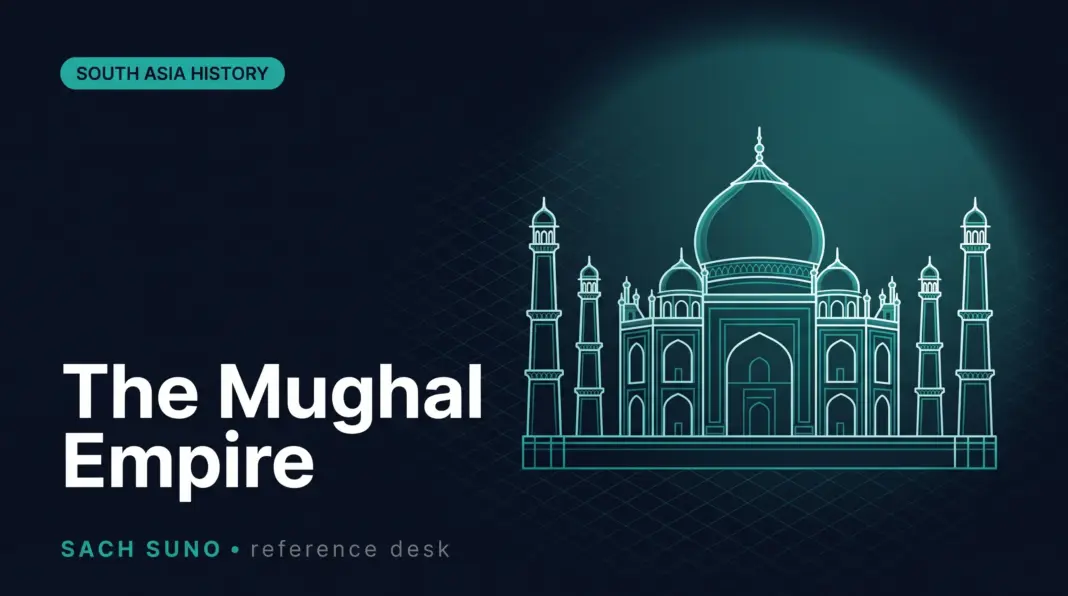
Mughal architecture remains one of the most visible forms of South Asian heritage. Lahore Fort and Shalimar Gardens in Pakistan, Humayun’s Tomb and the Taj Mahal in India, and many other sites show how Persian, Central Asian, Islamic, and South Asian forms were adapted into a distinctive imperial style. Gardens, water channels, calligraphy, marble, red sandstone, and geometric planning all became part of Mughal visual language.
These monuments should be appreciated as works of art, but also read as statements of power. They communicated order, wealth, devotion, dynastic legitimacy, and courtly taste. Their survival also creates modern responsibilities: conservation, public access, and respectful tourism matter because these sites belong to a shared historical inheritance.
Decline and regional change
The Mughal Empire reached great territorial extent under Aurangzeb, but expansion brought costs. Succession struggles, regional assertion, fiscal pressure, military overstretch, and outside invasions weakened central authority. By the eighteenth century, many regional powers operated with increasing independence even while Mughal symbols remained influential.
Decline did not mean cultural disappearance. Mughal administrative habits, artistic forms, foodways, language patterns, and elite practices continued to influence South Asia. The empire became part of the background against which colonial power and modern states later emerged.
Why it still matters today
The Mughal period is often pulled into modern identity debates. A better approach is to study it historically: as an empire with achievements, inequalities, violence, creativity, and long-term influence. That balanced reading gives South Asians a richer understanding of their shared past.
Sources and Further Reading
- Britannica: Mughal dynasty
- UNESCO World Heritage: Fort and Shalamar Gardens in Lahore
- UNESCO World Heritage: Taj Mahal
Last reviewed: 2026-05-07.