Editor’s note: This article is an educational history explainer written for general readers. It uses public reference sources and avoids sensational or unsupported claims.
Key Takeaways
- The Delhi Sultanate ruled north India from the 13th to the 16th century.
- Its power depended on military strength, governors, local elites, and revenue systems.
- The period shaped cities, architecture, language, and political practice.
A new political center
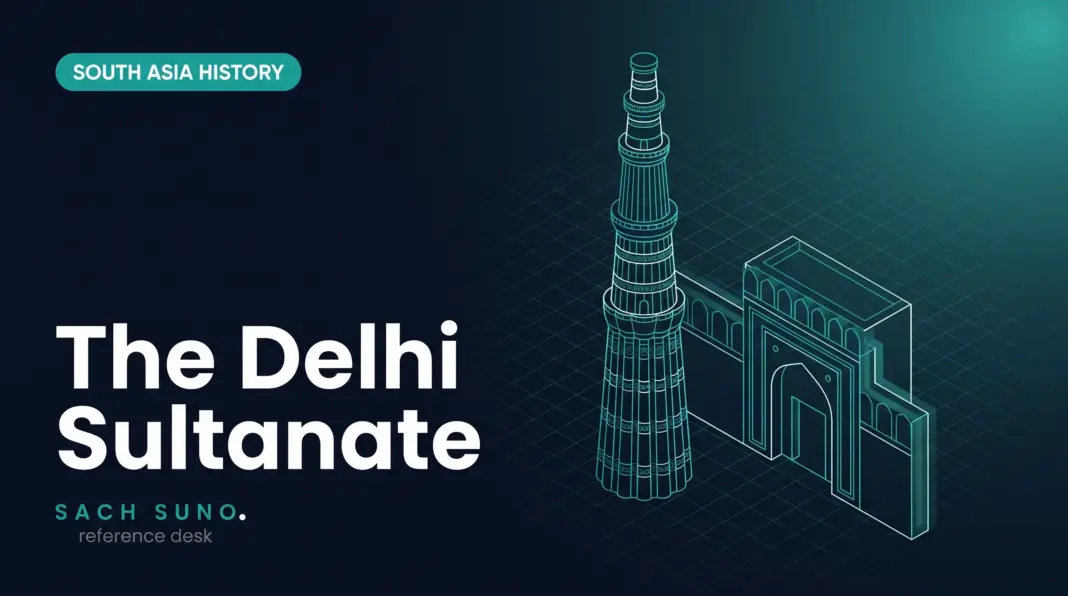
The Delhi Sultanate was the main Muslim-ruled state in north India from the thirteenth to the sixteenth century. It emerged from military campaigns and political change, but it survived because rulers had to do more than win battles. They needed revenue, officials, alliances, cities, and ways to govern a wide and diverse population.
Delhi became a major political center, but the Sultanate never controlled every part of South Asia in the same way. Its rulers dealt with local chiefs, governors, frontier pressures, and regional kingdoms. The state was powerful, but it was also negotiated through many layers of authority.
Ruling diversity
The Sultanate’s elite included Turks, Afghans, Khaljis, converts, soldiers, administrators, scholars, and local intermediaries. Religious identity mattered, but politics was not only a religious story. Rulers needed practical cooperation with Hindu officials, landed groups, merchants, and regional powers. The result was a complicated state rather than a simple one-dimensional regime.
The Sultanate also faced external pressure from Mongol expansion to the northwest. This threat shaped military policy and frontier defense. Internally, communication across large distances was difficult, which gave provincial officials considerable room to act. These conditions help explain why central authority expanded and weakened repeatedly.
Cities, culture, and change
The Delhi Sultanate influenced architecture, urban growth, coinage, language, and court culture. Persian became an important language of administration and high culture, while local languages continued to develop. Sufi networks, markets, mosques, madrasas, and craft communities contributed to the social life of towns and cities.
This period also produced conflict and inequality, as most medieval states did. A balanced view should neither romanticize nor demonize it. The Sultanate was part of a wider transformation in which South Asia became more connected to Persianate, Central Asian, and Indian Ocean worlds while maintaining strong local traditions.
Why it still matters today
The Delhi Sultanate helps explain later developments under the Mughals and regional states. It also reminds readers that medieval South Asia was politically creative, culturally mixed, and administratively complex. Understanding it makes modern debates about identity and heritage less shallow.
Sources and Further Reading
Last reviewed: 2026-05-07.