Editor’s note: This article is an educational history explainer written for general readers. It uses public reference sources and avoids sensational or unsupported claims.
Key Takeaways
- The Mauryan Empire was the first state to rule most of the subcontinent.
- Ashoka is remembered for linking political authority with ethical public messaging.
- Buddhist monuments and inscriptions show how ideas moved across the region.
A subcontinental empire
The Mauryan Empire, centered at Pataliputra near the Ganges, marked a major turning point in South Asian history. Earlier states had controlled important regions, but the Mauryan state extended authority across much of the subcontinent. This scale required administration, taxation, roads, officials, armies, and communication systems that could hold distant areas together.
The empire began with Chandragupta Maurya in the late fourth century BCE and reached its widest influence under Ashoka in the third century BCE. Its rise shows that South Asia was capable of large-scale political organization long before modern states or colonial administration. It also shows the difficulties of governing a region of many languages, landscapes, and local powers.
Ashoka after Kalinga
Ashoka is one of the best-known rulers in South Asian history because later traditions and inscriptions present him as a king transformed by the violence of conquest. After the campaign in Kalinga, Ashoka is associated with a public commitment to dhamma, often understood as ethical rule, social responsibility, restraint, and concern for human and animal welfare.
This should not be romanticized into a simple story of a perfect ruler. Ashoka remained an emperor with state power. What makes him historically unusual is that he used inscriptions to communicate moral and administrative messages across a vast realm. Those inscriptions suggest a ruler trying to shape public conduct, not merely collect revenue or win battles.
Buddhism and public memory
Ashoka’s patronage helped Buddhism spread within and beyond the subcontinent. Sites such as Sanchi preserve important evidence of early Buddhist architecture and artistic development. The spread of Buddhism was not caused by royal support alone; monks, merchants, pilgrims, local communities, and trade routes all mattered. Still, Ashoka’s reign gave Buddhism a powerful political and symbolic boost.
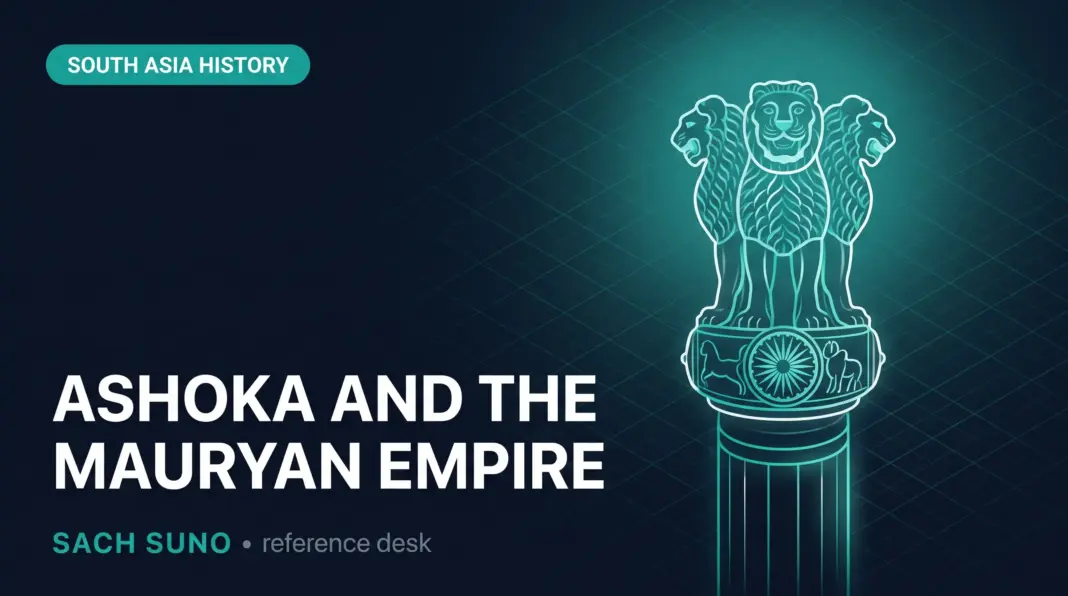
The Mauryan legacy survived in more than monuments. Later rulers, reformers, and modern states have returned to Ashoka as a symbol of rule guided by public ethics. India’s use of the Lion Capital of Ashoka in state symbolism is one sign of that memory, while Buddhist communities across Asia remember him in religious history.
Why it still matters today
The Mauryan Empire raises questions that still feel modern: how should power be limited, how should a diverse population be addressed, and how can public authority speak about ethics without becoming coercive? Ashoka’s answer was imperfect and ancient, but it remains one of South Asia’s most influential attempts to connect rule with responsibility.
Sources and Further Reading
- Britannica: Mauryan Empire
- Britannica: Ashoka summary
- UNESCO World Heritage: Buddhist Monuments at Sanchi
Last reviewed: 2026-05-07.